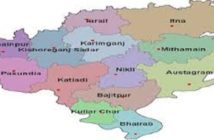

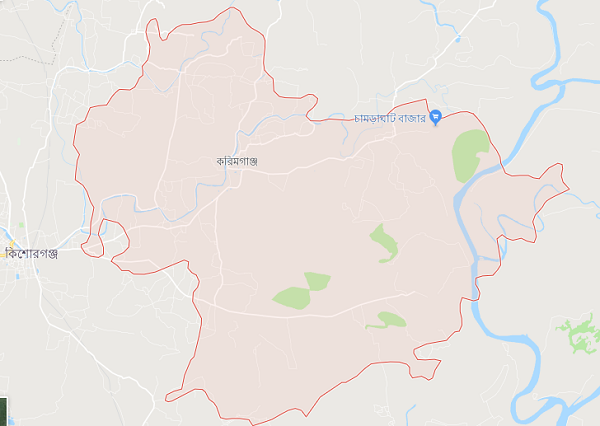
Karimganj Upazila (kishoreganj district) area 200.52 sq km, located in between 24°22′ and 24°32′ north latitudes and in between 90°48′ and 91°01′ east longitudes. It is bounded by tarail and itna upazilas on the north, nikli, katiadi and kishoreganj sadar upazilas on the south, Nikli and mithamain upazilas on the east, Kishoreganj Sadar upazila on the west.
Karimganj (city) consists of four mouas. It has 6.21 km area and 14440 population; Male 51.36%, Female 48.64% The density of population is 2325 per sq km. Literacy rate among the town is 34.5%.
Administration Karimganj thana was established in 1932 and it was turned into an upazila in 1985. Union 11, mouza 85, village 184
Archaeological heritage and relics Jangalbari Fort (hundreds of centuries), Isa Khan Shahi Mosque (16th century), Isa Khan Palace
Historical events Yaya Khan, the head of Bara Bhuiyan, terrified Jangalbari and defeated the coach, King Laxman Hajo. Isa Khan established his second capital in Jangalbari.
Marks of the War of Liberation Mass grave at village Boara of Joshundhu village
Population 237155; Males constitute 49.75%, females 50.25%; Muslims 96.94%, Hindu 2.55%, Buddhists 0.09%, Christian 0.09% and others 0.33%.
Religious institutions Mosque 550, temple 8
Literacy rate and educational institutions Average literacy 20.3%, male 25.3% and female 15.3%. Educational institutions: college 3, high school 14, junior high school 3, madrasa 15, government primary school 84, non-government primary school 32, satellite school 4; Noted educational institutions: Janglabari English School (1862), and Gujdaia Abdul Hakim High School.
Enhanced periodicals of the newspaper: Succas (1981), Shadhu Mashak (1988), Isha Kha (1988-1991), Shahojar Padabali (1992).
Cultural organizations Club 39, cinema hall 3, play stage 1, theater group 10, playground 21, women’s organization 1 and child park 1.
Main occupations Agriculture 42.38%, agricultural workers 24.7%, wage workers 2.78%, fishing 1.59%, transport 2.35%, service 2.88%, trade 12.9%, others 10.42%.
Total cultivable land land use 14870 hectares, fallow land 2.93 hectares; Single crop 22%, double crop 57% and treble crop 21%. Under cultivation cultivable land 85%
Land control Among the peasants 34% are landless, 49% marginal and small, 14% intermediate and 3% rich.
The price of the land is Rs. 2500 / – for every first grade land per 0.01 hectare.
Main crops Paddy, jute, wheat, mustard seeds, nuts, garlic, tomatoes, onions and pepper.
Extinct or nearly extinct crops Sesame, sugarcane, pea and aman paddy.
Main fruits Mango, banana, jackfruit, litchi, papaya and black berry.
Fisheries, dairies, poultries 157, poultry 18, fishery 20 and hatchery 1.
Communication facilities Roads: Pucca 21.40 km, semi pucca 1.40 km and mud road 525 kilometers.
Traditional transport palanquin, bullock cart. These databases of transport are extinct or almost extinct.
Manufactories Ice factory 8, welding 25, bakery 3, shovel work 1 and other small and medium industries factory 134.
Cottage industries Weaving 90, bamboo work 260, goldsmith 175, blacksmith 40, potteries 30, wood work 364 and tailoring 330.
Hats, bazars and fairs Hats and bazars are 32, most notably Karimganj, Baburhat and Murur Kandi.
Main exports Paddy, jute, vegetables, onion, garlic, chilli, mustard seed, banana and bamboo and cane products.
NGO activities Operationally important NGOs are BRAC, Annecha, Grameen Bank, BLS, Keds, Sarp, Surya Dukhi Mahila Samaj Kalyanan Sangstha, Vark, Zenith Foundation, RSDP, ORA.
Health centers Upazila health complex 1, satellite clinic 1, health and family welfare center.