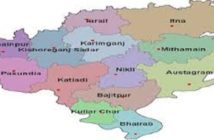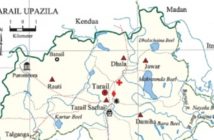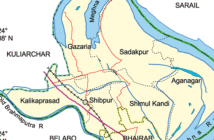

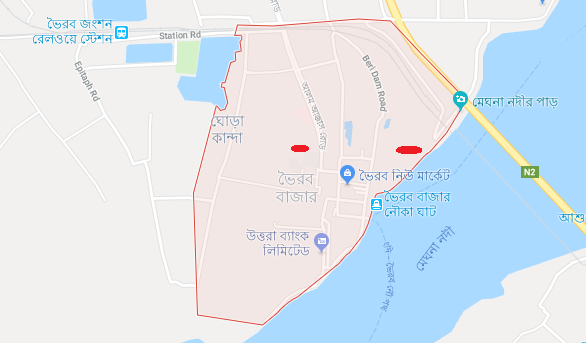
Bhairab Upazila (kishoreganj district) with an area of 139.32 sq km, Boyzipur upazila and meghna river on the north, ryapur and brahmanbaria sadar upazilas on the south, saral upazila and meghna river on the east, kulishar and eloba upazilas on the west. . Bhairab main river Meghna, ancient ancient Brahmaputra ancient heritage and architecture is Nilkutha Imambari, Gajania village of Jagannath Bhawan, Titummiya Bhaban, Rabindra Saha’s magnificent building at Bhairab Bazar.
History of the War of Liberation On 15th April 1971, the Pak army killed about 400 civilians, including 250 Ibrahimpur villages. They also killed many people in Manikdi mosque and Ashuganj. On December 13, the Pak army destroyed the Bhairab Railway Bridge
Marks of the War of Liberation Memorial mark 1 Bhairab (Bhairab Bus Stand) in Durza, Memorial Monument 1 Halanga Khighat (Paniala Char)
Religious institutions Mosque 208, temple 7, tomb 13, (holy bath).
Literacy and educational institutions Average literacy 40.7%; Males constitute 44.8%, Female 36.6%. Noted educational institutions: Haji Asmat College (1947), Bhairab Technical School and College (1980), Rafiqul Islam Girls’ High School, College (1987), KB High School (1919), Bangladesh Railway High School (1954), Srinagar High School 1 9 61), Bhairab MP Pilot Girl’s High School (1962), Kalika Pradas High School (1964), Jagannathpur Purana Primary School (1995).
Important installations and tourist stains, Bangladesh-British Friendship Bridge, Bhairab Railway Bridge, Botanical Gardens on the banks of the Meghna river.
Cultural organizations Library 14, theater group 4, theater stage 1, cinema hall 3, voluntary society 65, women organization 3, literary society 3.
The main source of income is 30.08%, irrational workers 10.17%, industrial 1.51%, business 23.54%, transport and communication 3.87%, service 8.86%, construction 1.69%, religious services’ 0.20%, rent and remittance 2.14% and others 17 . , 94%
Main crops Paddy, jute, peanut, mustard, sugarcane, wheat, potato, pulse, sesame, chilli, coriander, ginger, turmeric, vegetables.
Fisheries, dairies and poultries Fishery, dairies 175, poultry 182, hatchery 1.
Communication facilities Roads of birds 127.22 km, semi-fabled road 6.10 km, canal road 125.21 km; Waterway 6.48 nautical miles; Rail 12.27 km
Noted industries include jute mill, rice mill, threaded rice (slit) mill, steel mill, biscuit factory, gold factory, BG factory, re-rolling industry, silicon industry, welding factory.
Cottage industries Goldsmith, weaving, miracle industry, potteries, weaving, forestry, cane work.
Main exports Fish, bidi, biscuit, lungi, towel.
Power utilization: All wards and unions are under rural electrification program but 51.31% households have access to electricity.
Water sources of water are good tubes-93.71%, pond 0.11%, tap 2.01% and others 4.17%. The presence of arsenic in the water of 29.95% of Aausal tube in this upazila is available.
Sanitary Upazila Health Complex 39.74% (24.62% of villages and urban 65.16%) sanitary latrines use 45.51% (urban 55.38% and 28.90% of urban households), using non-sanitary latrines; 14.75% of households do not have latrine facilities.
Health centers Upazila health complex 1, health and family welfare center 5, railway hospital 1, satellite clinic 2, community clinic 7, clinic.
Natural disasters have been damaged due to damage and losses suffered by floods of 1974, 1988, 1998 and 2004, loss of livestock, crops and other resources.