Kishoreganj Districts

Google+ Pinterest LinkedIn Tumblr +
Kishoreganj Districts History of Kishoreganj is the oldest. There is a well-organized group since ancient times and it still exists. In the sixth century Nandikishore, son of Krishnadas Pramanik, a resident of Batris, established a ganj on the bank of Brahmaputra river; From time to time, Nandkishore’s Ganj or ‘Kishoreganj’ originated. In the eleventh and twelfth centuries Pal, Varman and Sen rulers ruled in this region. After them, small independent independent tribes, Hajong, Garo and Rajbangshis live here. In 1491 most of Mymensingh was under Firoz Shah, but Kishoreganj remained outside the Muslim rule. Later during Mughal emperor Akbar’s period, most of the territory was under the Mughal empire, but Jangalbari and Egarasindu remained under the coaches and Ahoms rulers. In 1538, the eighth ruler of Egarasindu was defeated by the Mughals and in 1580, near the Jangalbari coach, Isa Khan. In 1580, Isa Khan, the leader of Bar-bhuiyans, defeated Man Singh Singh, commander of Akbar in Egarasindhur. After the death of Isa Khan, Jangalbari and Egarasindu came under his son Musa Khan but in 1599 he was defeated by the Mughals.

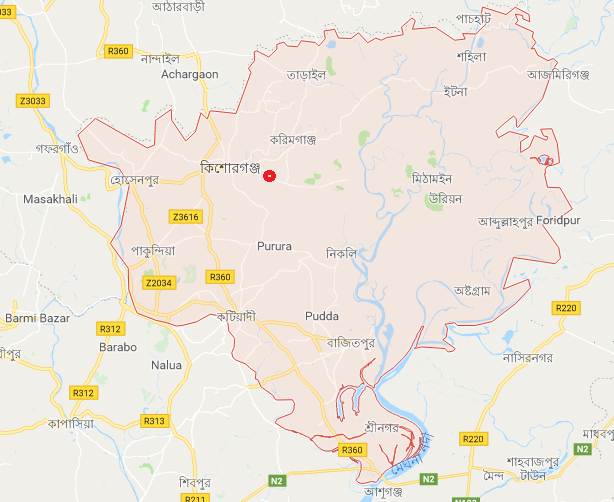
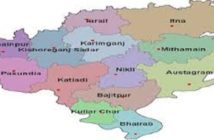
Kishoreganj upazila number 13 Such as:
Kishoreganj Sadar Upazila
Ashtagram Upazila
Itna upazila
Karimganj Upazila
Katiadi upazila
Kuliarchar upazila
• Tarail upazila
• Nikki upazila
Pakundia upazila
• Bajitpur Upazila
• Bhairab Upazila
• Mitamin Upazila
• Hossainpur upazila
Number of unions: 106
 

The driving force of Kishoreganj economy is very much on the haor. For example, there is abundant fish available in haor, which can fulfill the country’s demand for dividends. Moreover, there are jute, rice and many other vegetables in Kishoreganj which are exported outside the country.
The Jangalbari fort was the second capital of Isa Khan, the head of Bar-bhuiyans. It is located in Jangalbari village of Kadirjangal union of Karimganj upazila, 6 kilometers from Kishoreganj town. Inside the fort, Jesus khan set up several structures. In 1897 some parts of the fort were damaged in the earthquake.
Egarasindura’s fort is situated at village Egarasindur of Pakundia upazila. The village is situated on the eastern bank of the Brahmaputra River. The name of this village is mentioned in the book Akbarnama written by historian Abul Fazl. It was the capital of the Ahom rulers. In 1538, the Mughals defeated Ahmad and occupied the region. Here, in 1580, Chief of the Bhuiyans, Isa Khan, defeated Man Singh, the commander of the Mughal emperor Akbar.
Kishoreganj Sadar upazila is situated on the eastern side of Bangladesh’s largest and traditional Sholakia Eidgah ground in the subcontinent, situated in approximately 6.61 acres of land. Eid-ul-Fitr and Eid-ul-Azhaar prayers were held in the field every year. Sholakia Eidgah has turned into a historic place in the period of time. Sholakia, who came from far away Yemen for preaching the divine message of Islam, Sufi Syed Ahmed, an ancestor of ‘Saheb Bhabari’, organized his Eid congregation in 1828 on the river Narsunda. Sufi Syed Ahmed himself was the Imamati in that church. According to many, he used the word ‘Sawa Lakhar’ in Munajat to express the abundance of the devotees. According to another, the gathering of 1 lakh 25 thousand (that is, half a million) people in that day’s assembly. As a result, its name is ‘Sawa Lakhi’. Later, the name Sholakia was introduced in the evolution of pronunciation. Some others also said that the amount of pargana revenue in the Mughal period was about Rs. 100 lakhs. In the evolution of the word, from Soyakhya to Sokalakhia, from there Sholakia. Later in 1950, local Dewan Mannan Dad Khan donated an additional 4.35 acres of land to the Maidan.
Shivamandir of Chandrabati, the first Bengali woman poet memorialist Shivmandir, built in the sixteenth century. It is located on the banks of the river Phulseshwari at Kacharipara village of Maijkhapan Union, 6 kilometers away from Kishoreganj town.
The Akhara of Delhi was built during Mughal Emperor Jahangir’s regime. It is located in Mithamain upazila.
Human Babu’s house is situated at Gongatiya village under Govindapur Union under Hossainpur upazila. In 1904, the estate was acquired by Bhupati Nath Chakraborty of Gangetia for the purchase of zamindari from the British JP Wise. There he built this house.

Share.

About Author