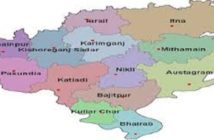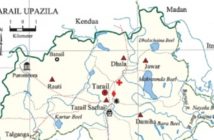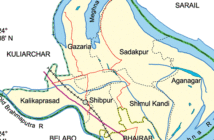

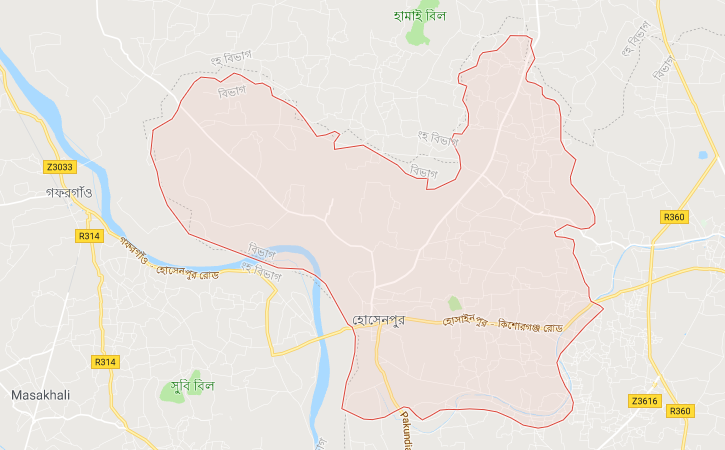
Hossainpur Upazila (Kishoreganj district) area: 121.29 sq km, 24 ° 23 ‘to 24 ° 31’ north latitudes and 90 ° 34 ‘to 90 ° 44’ east longitudes. Nandal upazila on the north, pakowdia and gafargaon upazilas on the south, gafargaon upazila on the west, kishoreganj sadar upazila on the east, gafargaon upazila on the west.
Population 161979; Male 82201, female 79778; Muslim 158448, Hindu 3382, Buddhist 42 and other 107.
Water bodies Main rivers: old Brahmaputra and Narasundar; Panan, Hanzail and Sukoni belle are notable.
Archaeological heritage and abolition of Pataaganj blue kuthi (1800), temple (1800) in the palace of the Gangetia zamindar, Kooleshwari Bari Kalimandal (seventeenth century).
History of the War of Liberation During the war of liberation, freedom fighters killed 39 Pak soldiers and took huge amounts of arms and ammunitions in a clash in Husainpur. On 18 November the freedom fighters destroyed a bridge by explosives. They attacked Razakar camp and captured 14 Razakars with their weapons.
Marks of War of Liberation Place of massacre 1 (mass killing site of Kurighat, in front of Hossainpur Police Station), Marks 1 (Shaheed Manjur Gate)
Religious institutions Mosque 209, graveyard 10, temple 2, akhra 2.
Literacy and educational institutions Average literacy 36.6%; Males constitute 38.6%, Female 34.6%. Educational institutions: college 4, secondary school 21, madrasa 13. Noted educational institutions: Gobindapur High School (1918), Hossainpur Pilot High School (12020), Hossainpur High School (1936), Pipalkandi High School (1941) ), Madhakhola Fazil) Madrasa (1929).
Main sources of income Agriculture 65.81%, non-agricultural laborer 3.67%, industrial 0.25%, trade 11.98%, transport and communication 2.89%, service 4.81%, construction 0.93%, religious services 0.17%, rent and remittance 1% and others 8.49%.
Main crops Paddy, jute, wheat, potato, mustard seed, sugarcane, betel leaf, rice, vegetables.
Extinct or nearly extinct crops Local varieties of rice, Kalai.
Main fruits Mango, blackberry, litchi, jackfruit, banana, papaya, custard apple, coconut, palm, star apple, Indian apple.
Fisheries, dairies and poultries Fishery 1, dairy 10, poultry 14, hatchery 20.
Extinct or nearly extinct traditional transport Palanquin, horse carriage, bullock cart.
Fisheries, rice mill, sugarcane, ice factory, biscuit factory.
Cottage industries Goldsmith, potteries, blacksmith, bamboo and wood work, tailoring.
Main exports Paddy, jute, wheat, potato, sugarcane molasses, banana.
Use of electricity All the unions of the upazila are under rural electrification net-work. However 16.52% of the dwelling households have access to electricity.
Drinking water tube -94.91%, pond 1.28%, 0.34% tap and 3.47%. 4.99% arsenic found in shallow tube-well water of the upazila.
Health centers Upazila health complex 1, family planning center 5, satellite clinic 6.
NGO activities Operationally important NGOs are BRAC, Proshika etc.