
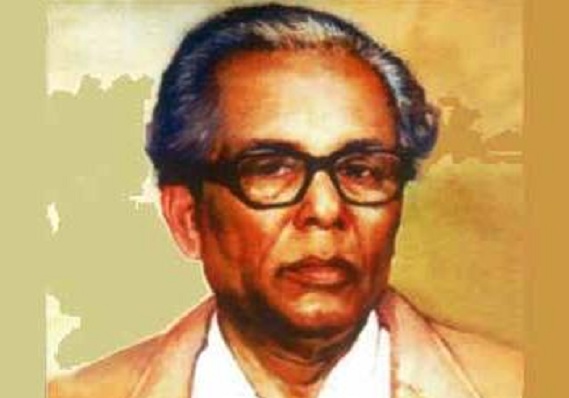
Zainul Abedin (1914-1976) is an internationally renowned talented artist. He is the pioneer of modern art movement in Bangladesh through the establishment of the Institute of Arts and Crafts. In 1948, he was founding Principal of the institute (presently the Institute of Fine Arts). He was well-known for organizing other artists by his leadership qualities. He was able to do this in a place where there was no institutional or professionally traded tradition of art in the very near future. In just a decade, modern art took place in Bangladesh in the endeavor of Zainul Abedin and some well-wisher colleagues. Zainul Abedin was given the title of Shilpacharya for his extraordinary art-mentality and imagination.
Zainul Abedin was born in 1914 in Mymensingh. He grew up in the green symmetry of Brahmaputra. In his early life Zainul received inspiration for romanticism between rivers and untold nature. In 1933, he was admitted to the Kolkata Government Art School and he studied British / European style for five years. In 1938, he joined the Faculty of Art School and he continued to paint his works. In 1938, he received the Gold Medal for his paintings of Jalrang in the All India painting exhibition. The main theme of his illustrations was the Brahmaputra River, which was his hopeful inspiration. This recognition brought him to the center of discussion for the first time. He got the confidence of creating a genre himself.
‘Famine’ (1943), ink and tuli
Abbeen’s appearance in the Oriental section seems to have been highly dependent and unchanging, which could not satisfy him. On the other hand, the European section was revealed to him as limited. He was attracted to Realism. His weakness on line painting remains, and in the introduction of daily life, he has brought many diversity in its use. In the famine of 1943, Zainul Abedin consistently sketched several images. Thousands of people died in this famine. The Chinese Ink and Tuli Achare on the cheap packing paper showed the painting of ‘Zainul’, ‘the curtain of famine’, the brutality and moral corruption of the cremation grounds, and the inhuman torture of the oppressed. The paintings give Zainul the fame of India. But more importantly, they develop their self-esteem in drawing a realistic picture by bringing human suffering, hardships and protests forward. ‘The Rebel Crow’ (Watercolor, 1951) is the most brilliant example of this trend. Combined with high-tech aesthetics, this collective expression of social inquiries and protests has spurred Zainul at different times, such as: During 1969 and 1971, Zainul did some of his significant works in A-style.
After the partition of the sub-continent in 1947, Zainul Abedin started living in Dhaka, the capital of East Pakistan. At that time, there was no art institute or any other industrial organization in Dhaka. Zainul Abedin and some of his associates, who had migrated to Dhaka after partition, founded the Art Institute. In 1951, he received two years’ training at the Slade School of Art in London. After returning from London, there is a new section seen in Zainul’s figure, which can be called ‘Bengali Section’. In this section, in the absence of primary color use and in the absence of perspective, rural subjects make their presence appear in geometrical form, sometimes semi-abstract approaches. ‘Two Women’ (Goyash, 1953), ‘Pyaayer Maa’ (Goash, 1953) and ‘Mahila’ (Jalarang, 1953) are important works of this period.
‘Crop Threshing’, Watercolor (1963)
Throughout the Fifteenth and Sixties, Zainul Abedin’s work was noticed in his work on realism, aesthetics, rural subjects and primary color. However, with the increase in the scope of work, he realized the limitations of the art of art. The lack of dimension here, the absence of close contact with light, and the lack of speed are noticeable. To overcome this limit, Zainul went back to nature, in rural life, in the daily struggle of life, with the combination of customary diversity, in which the reality will be the main, but the modern will be modern. The ‘modernism’ was not just abstraction at Zainul, but to him, the word “modernism” was an intrinsic significance of social development and personal expression.
Therefore, the strong physical function of men and women struggling against natural and man-made barriers reminds the important concept of modernism in the individual constraints. Zuneul’s actions have been centered in the labor and struggle of men and women against all adversities and with their manifestation of power. Based on the victory of the mass upsurge of 1969, its diversity is seen in the 65 foot-long scroll painting (Chinese Ink, Watercolor and Wax) ‘Navban’ and the 30-feet-long ‘Manpura’ painting for the memories of thousands of people who died in a fierce cyclone in the 1970s. Although Zainul has painted the nature and human life figure (including the personal moments of the village women), in the late 1960s and 70s, the motion and movement between his picture burst out.