
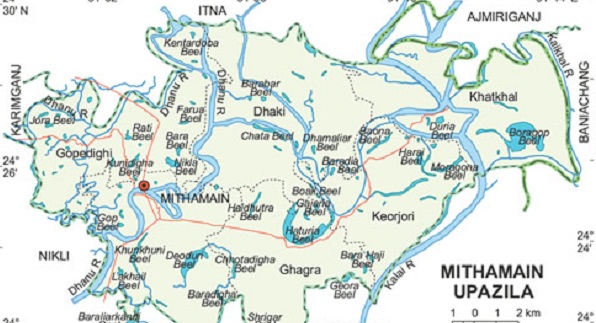
Mithamain Upazila (Kishoreganj district) is about 222.92 sq km, 24 ° 22 ‘to 24 ° 30’ north latitudes and between 91 ° 00 and 91 ° 15 ‘east longitude. It is Tista and Azimiganj upazilas on the north, Ashtagram upazila on the south, Bananiag and Ashtagram upazilas on the east, Karimganj and Nikoli upazilas on the west.
Population 122200 total; Male 63232, female 58968; Muslim 112767, Hindu 9312 and others 121.
Water bodies Main rivers: Dhanu, Kalai; Barogop, Gajaria, Deodri, Sirhargar, Rati and Nikli Bill are notable.
On November 1, 1971, the Pak army killed 28 people in Dhubuza village and brutally killed them and killed 3 people in Tilkhai village.
Marks of War of Liberation Mass killing 1 (Boara)
Religious institutions Mosque 105, temple 17, tomb 3, akhra 3. Noted religious institutions: Hazrat Shah Tamizuddin (R), Malek’s Dargah, Delhi Akra, Ghagra Gowda’s Goswami ‘Akra
Literacy and educational institutions Average literacy 15.6%; Male 20.7%, Female 10.2%. Educational institutions: college 1, secondary school 8, primary school 76, community school 10, madrasa 25.
Cultural organizations Library 1, club 30
The main source of income is 82.48%, non-agricultural laborer 2.32%, industrial 0.20%, trade 7.26%, transport and communication 0.24%, service 2.33%, construction 0.56%, religious service 0.21%, rent and remittance 0.20% and other 4.20%.
Ownership of agricultural land Landowner 60.34%, landless 39.66%; Owners of agricultural land: Urban 63.33% and rural 60%.
Main crops Paddy, mustard, potato, hay, nut, vegetables.
Extinct or nearly extinct crops Linseed, sesame, kaun.
Fisheries, dairies and poultries Dairy 22, poultry 26
Communication facilities: semi-finished roads 1.3 km, mud road 165 km; Waterways 35 nautical miles
Extinct or nearly extinct traditional transport Palanquin
Manufactories Ice factory, bakery.
Cottage industries Goldsmith, blacksmith, potteries, wood work.
Hats and bazars are 11, most notable among the Hatbazar, Mitman Bazar, Gopipigibazar and Dhakka Bazar.
Main exports Paddy, nuts, potato, tart.
Use of electricity All the unions of the upazila are under rural electrification net-work. However 10.94% of the dwelling households have access to electricity.
Drinking water tube -90.35%, top 0.24%, pond 2.85% and others 6.56%. In the case of 20.5% of shallow tube wells of the upazila, presence of arsenic has been detected in an unstable phase.
83.37% (rural 85.08% and urban 68.18%) use sanitary latrines using sanitation latrines, 9.04% (7.08% rural and urban 26.38% urban) and sanitary latrines; 7.59% of households do not have latrine facilities.
Health centers Upazila health complex 1, health and family planning center 1, union health center 2, community clinic 14.