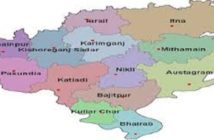

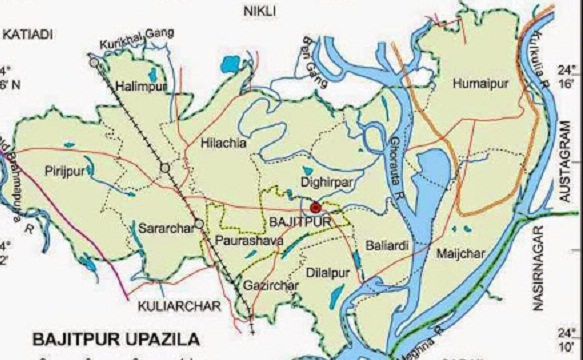
Bajitpur Upazila (Kishoreganj district) is about 172.18 sq km, is located between 24 ° 09 ‘to 24 ° 18’ north latitudes and 90 ° 50 ‘to 91 ° 03’ east longitudes. Katiadi, Nikoli and Ashtagram upazilas on the north, Kurichar, Bhairab and Sarail upazilas on the south, Ashtagram and Nasirnagar upazilas on the east, Katiadi upazilas on the west.
Population total 210375; Male 105988, female 104387; Muslim 188318, Hindu 21 thousand 811, Buddhist 13 and others 63.
Water bodies Main rivers: Meghna, Old Brahmaputra, Dhaleswari, Ghorata; Notable canals: Sialadi, Kadangi, Barkal, Bhabdia and Chiban; Notable Beel: Bengla, Barun, Auroudi and Landy Navalis of this district became famous during British rule. A blue center was established in Gopinathpur and Ghoraghat. In this region, pearls of Bharti region were planted.
Fakir-Shanaji rebellion spread widely in the spread of Bajitpur
During the war of liberation Mukti Bahini defeated the Pak army by defeating the Pak army and rescued Bajitpur on 26 October. In the Pakistani army, seven freedom fighters were killed in clashes with the Pak army, killing about 400 innocent people and 60 women lost their purity
Good quality muslin
Bajitpur is famous for producing great quality, known as Tanjab. During the Mughal regime, the Jamdani making industry reached its peak. Most of the villages in Dhaka district had handloom. Bajitpur’s altar is famous for making famous Jamdani and Mashalin among Dhaka, Sonargaon, Dhamrai, Titabari and Jangalbari. In addition to Europe, Iran, Armenia traders, Mughal-merchants also use these clothes. The Mughal emperors, Nawab of Bengal and other elites, bought high quality muslin and jamdani by employing agents in Dhaka.
After the release of Bangladesh, a Jamdani village was established in Dhaka near Dhaka to provide financial support for Bumper. However, Jamdani traders from other areas suffer from the lack of support and support of their labor and skills. In the district of Kishoreganj district, the silence of the silent deficit of the village of Madurapur village. This village was once famous for producing jamdani cloth and fancy fabrics with 100/300 cotton yarn.